
An international team of scientists led by Prof. Philip King from the University of St. Andrews and Dr. Mohammad Saeed Bahramy from the University of Manchester has made a major discovery in the emerging field of moiré quantum materials. The research, published in Advanced Materials, reveals how resonant interlayer coupling in epitaxial superlattices of monolayer NbSe₂ grown on graphite reshapes the electronic structure of the system. The work combines state-of-the-art angle-resolved photoemission spectroscopy with advanced theoretical modelling, performed on the MASAMUNE-IMR supercomputer at the Center for Computational Materials Science (CCMS) in collaboration with Associate Professor Rodion Belosludov from the Institute for Materials Research, Tohoku University.
Moiré superlattices arise when two atomically thin materials with slightly different lattice constants or relative twist angles are stacked together, forming interference patterns. These structures have become a playground for discovering new electronic phases — from unconventional superconductivity to correlated insulating states — because the moiré pattern acts as a powerful “designer potential” that engineers how electrons move through the material.
In the new study, the researchers demonstrate that moiré interactions can be created not only through manual stacking of exfoliated layers, but also using molecular-beam epitaxy to grow high-quality, large-area heterostructures directly. Probing these epitaxial NbSe₂/graphite systems, the team uncovered clear spectroscopic signatures of a moiré superlattice and identified how electronic states from NbSe₂ and graphite become strongly intertwined.
Crucially, the team found that replicas of the graphite Dirac states appear at new locations in momentum space, where they intersect with the Fermi surface of NbSe₂. At these crossings, the moiré lattice enables momentum-conserving tunnelling between layers, opening small hybridisation gaps and reshaping the Fermi surface in a highly selective way. The modelling reveals that this “resonant interlayer coupling” arises when the Fermi surfaces of the two materials are closely matched in energy and momentum.
This behaviour has profound implications. NbSe₂ is already known for hosting collective phenomena such as charge-density-wave (CDW) order and Ising superconductivity. The new results show that moiré-induced gaps appear exactly where the CDW gap would normally form, meaning that moiré coupling can directly compete with — and even suppress — the CDW instability. More broadly, the work demonstrates that moiré engineering can be used not only to create new electronic states, but also to tune or destabilise those that naturally exist in layered quantum materials.
The discovery marks a significant step toward building controllable, large-area quantum materials platforms — with potential long-term applications ranging from next-generation electronics to new paradigms of exotic quantum states.
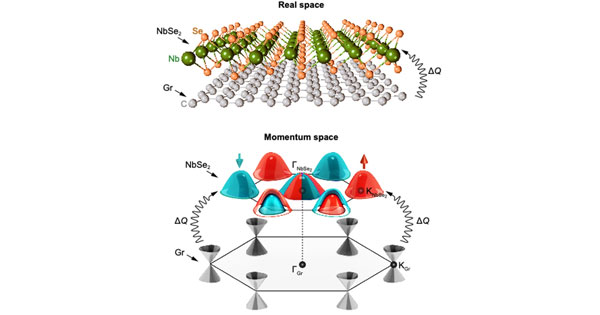
Figure 1. Formation of a moiré superlattice in monolayer NbSe₂ grown on graphite. Top panel: The atomic stacking of NbSe₂ on graphite, where a slight lattice mismatch creates a repeating moiré pattern in real space. Bottom panel: Illustration of how this pattern reshapes the electronic structure in the momentum space, allowing electrons to tunnel between the interfacing layers at specific momenta. © P. D. C. King and M. S. Bahramy
Publication Details
Title
Authors
Journal
Advanced Materials
DOI
Online publication date
December 19, 2025